Red Poppies Sublimation Clipart: A Designer's Guide to Vibrant Floral Assets
Capturing the Essence of Watercolor Botanicals
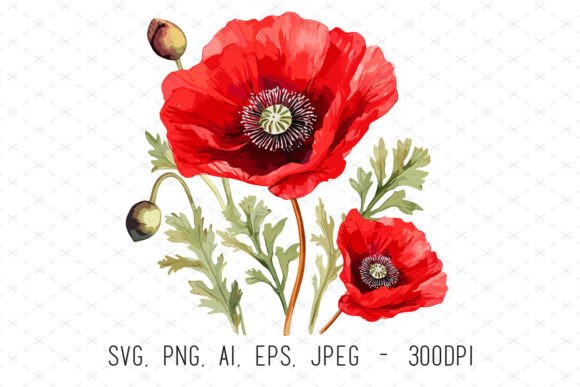
There is a specific kind of energy that red poppies bring to a design project. They are not just flowers; they are statements of bold color and delicate form. When you work with Red Poppies Sublimation Clipart, you are tapping into a visual language that communicates passion, remembrance, and natural beauty. This particular collection is built around a watercolor aesthetic, which gives the artwork a hand-painted, organic feel. Unlike flat vector graphics that can sometimes feel sterile, these watercolor poppies have texture, depth, and subtle variations in hue that mimic real pigment on paper.
The visual personality of this clipart set is versatile yet distinct. The reds are rich—ranging from deep crimsons to brighter scarlets—creating a natural focal point in any composition. Because the files are provided at 4500x4500px and 300 DPI, the quality holds up even when you zoom in on those intricate brushstroke details. This high resolution is critical for professional applications, ensuring that the texture doesn't blur or pixelate when printed on large formats. The inclusion of transparent backgrounds allows these elements to float effortlessly over other design assets, making them ideal for layering in complex compositions.
Practical Applications: From Screen to Surface
The true value of a design asset lies in its utility. While the name suggests a specific use case, the reality is that these files are incredibly adaptable. For entrepreneurs and small business owners, this clipart set serves as a foundation for physical product design. Because the files are optimized for sublimation, they are perfect for printing on hard surfaces like ceramic mugs, coasters, and phone cases, as well as textiles like tote bags and t-shirts. The watercolor style translates beautifully to fabric, giving merchandise a boutique, artisanal quality that mass-produced graphics often lack.
For those in the digital space, such as bloggers and content creators, the PNG and JPEG formats are ready for immediate use. You can drop them into website headers to add a seasonal touch or use them as backgrounds for social media graphics to catch the eye of scrolling users. However, the inclusion of SVG, AI, and EPS files elevates this set to a professional grade. These vector-compatible formats allow for infinite scalability without loss of quality. A graphic designer working on a wedding invitation suite can scale the poppies to fit a small envelope seal or a large welcome sign without having to source new artwork. This scalability is a massive time-saver in packaging design and editorial design, where assets often need to adapt to various dimensions.
Integrating Floral Art into Brand Identity
When building a brand identity, consistency is key. Using Red Poppies Sublimation Clipart across multiple touchpoints creates a cohesive visual narrative. Imagine a bakery using these poppies on their menu, their Instagram stories, and their takeaway packaging. The repetition of that specific watercolor style reinforces brand recognition. However, it is important to consider the "voice" of the flower. Red poppies are bold. In a layout, they should be used to guide the viewer's eye, acting as visual anchors that break up text-heavy sections.
Readability is a major concern when incorporating decorative elements. A common mistake is placing busy floral art directly behind body text. Instead, use these poppies to frame content. Place them in the corners of a flyer or use them as dividers between sections. If you are designing a logo, you might find that a single, stylized poppy works better than a full bouquet to maintain clarity at small sizes. The goal is to use the clipart to support the message, not overpower it. When paired with a clean sans serif font, the organic, flowing lines of the watercolor poppies create a beautiful contrast—balancing modern typography with natural artistry.
Technical Flexibility and Workflow Efficiency
One of the standout features of this collection is the breadth of file formats provided. In modern design workflows, flexibility is everything. Having access to an AI (Adobe Illustrator) file means you can edit the vector paths if needed, adjusting the composition to fit a specific layout. The EPS format ensures compatibility with older software or different vector editors like CorelDRAW. Meanwhile, the SVG format is becoming the standard for web design, allowing for lightweight, scalable graphics that load quickly on mobile devices.
For the crafter or hobbyist, the ease of resizing cannot be overstated. Whether you are using Canva, Procreate, or the Adobe Creative Suite, these files are designed to be user-friendly. You don't need to be a technical wizard to make them look good. The transparent background feature is particularly vital here; it eliminates the hours of tedious masking or "knocking out" backgrounds that often plagues stock imagery. You simply drag, drop, and resize.
Choosing the Right Asset for Your Project
When evaluating if this specific clipart set is the right fit, consider the emotional tone of your project. Red poppies evoke strong feelings. They are excellent for projects related to spring, summer, gardening, remembrance, or passion. If your project requires a softer, more pastel look, you might need to color-adjust the files, which is easy to do with the vector formats. If you are creating greeting cards or invitations, the high detail of the watercolor texture adds a layer of luxury and craftsmanship that clients appreciate.
Ultimately, Red Poppies Sublimation Clipart